Guilin’s landscape has been celebrated for a millennium as the finest under heaven: a plain of limestone towers and cones, the Li River threading through them, and fishermen’s cormorants working the shallows at dusk. The city itself is old — founded in 214 BC when the Qin dynasty cut the Lingqu canal here — but the scenery, not the monuments, is the reason to come.
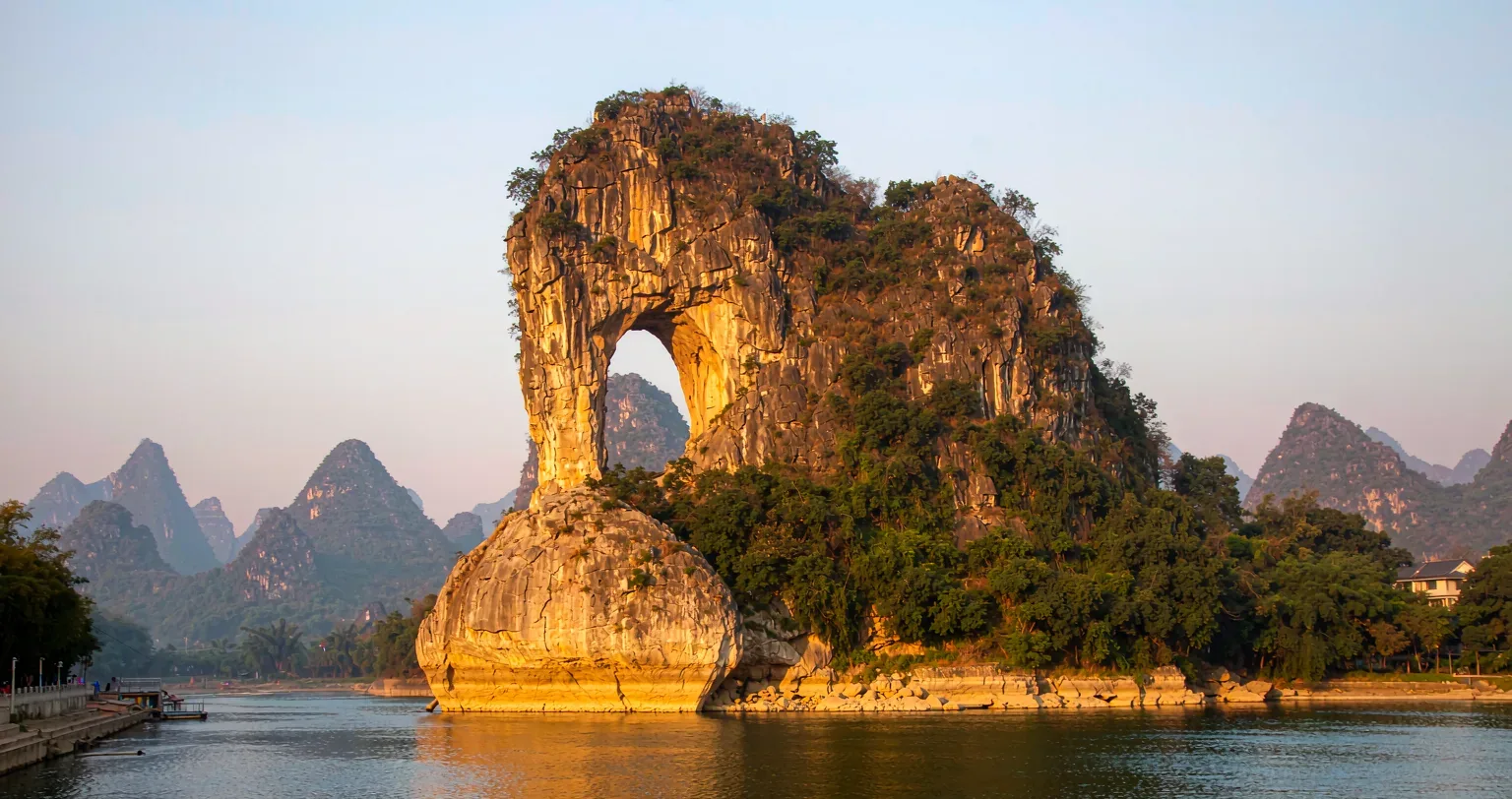
The classic move is the 83-kilometre Li River cruise from Guilin to Yangshuo, past water buffalo and bathing villages, to a town of limestone pinnacles and bicycle lanes along the Yulong River. In Guilin itself, Elephant Trunk Hill frames the river mouth at dawn and Reed Flute Cave lights its stone draperies after dark.
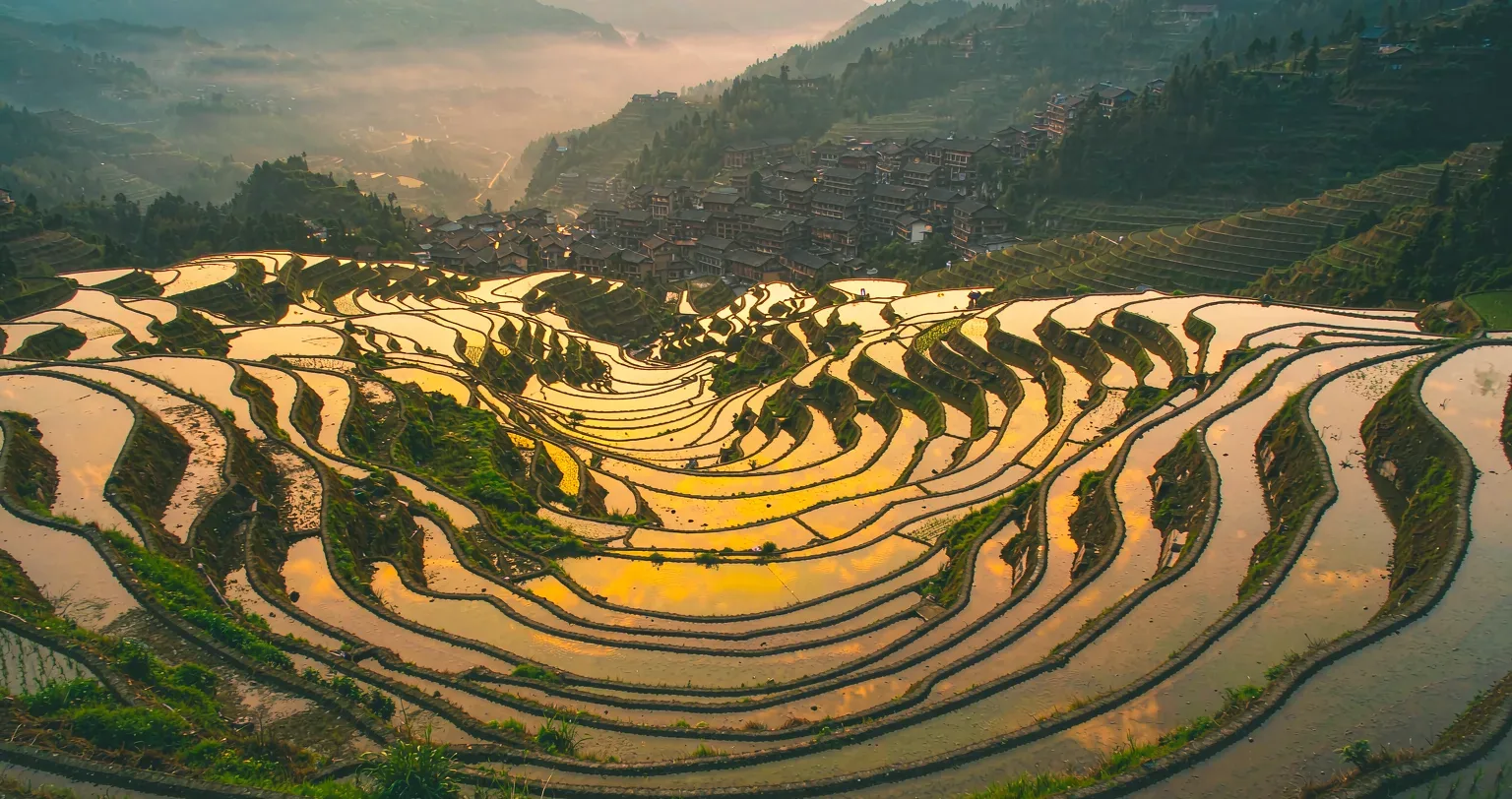
Two hours north by road, the Longji rice terraces stack from the valley floor to the cloud line — sculpted by Zhuang and Yao villages over some 650 years, green in summer, liquid gold after the autumn harvest.
For the record: about five million residents across the prefecture; a karst terrain formed over some 300 million years; rice noodles for breakfast as the non-negotiable local institution; and two high-speed stations putting Guilin within three hours of Guangzhou and Changsha alike.
The elephant that refused to leave
Heaven sent an elephant down to carry treasure; seeing how hard the Li River folk farmed, it stayed to plough their fields. The gods ran it through with a sword — and the elephant became the stone hill now called Elephant Trunk Hill, the sword hilt still standing on its back as the Puxian Pagoda.
The songs of Liu Sanjie
The song fairy Liu Sanjie out-sang the landlords' scholars three at a time, then rode a carp up to heaven. Fishermen still sing to the cliffs at dusk; in Zhuang country they say anyone who can sing learned it from her.
Ma Yuan, the Wave-Calming General
Han's southern expeditionary commander gave Fubo Hill its name; the Sword-Testing Stone in its cave is said to be the rock his blade sheared clean through.
Wang Zhenggong
A Song official who raised a toast to examination candidates and wrote 「Guilin's scenery is the finest under heaven.」 The line, carved on Solitary Beauty Peak, has been advertising the city for eight hundred years.
Xu Xiake
The great Ming travel diarist spent his last long survey in Guangxi — descending sinkholes on ropes, charting the Li. His Guilin measurements still earn nods from geologists.
Li River, before the ferries
A small craft from Zhujiang Pier at first light — the ninety-kilometre scroll with the water to yourselves.
Yangshuo after the buses
The back lanes and river bends by bike, then a fisherman's cormorant scene at dusk.
Longji rice terraces
The Dragon's Backbone with a Zhuang family lunch — the village above the postcard.
A chef's market morning
Guilin's wet market with the chef who cooks your lunch — river snails, taro, pickled plums.
Reed Flute, quietly
The illuminated cavern on a private early slot, before the loudspeakers start.
Liu Sanjie from the water
The river's night spectacle watched from a private raft — not the stands.
Mist at Zhujiang Pier
The small craft leaves before the ferries — the scroll unfolds from the first light.
Nine Horses
Reading horses in the cliff — the boatman knows the best angle to hold.
Yangshuo's back lanes
Bike the lanes once the coaches leave — then watch the cormorants work at dusk.
Night show from the water
The river spectacle from a private raft — the moment the lit hillside comes on.
Where you sleep
A riverside design hotel in Yangshuo with the karst as wallpaper; a restored farmhouse among the Longji terraces; and in Guilin town, the quiet park-side best of a simple stock.
What you eat
Guilin rice noodles at the shop the city wakes up for, beer fish in Yangshuo's oldest courtyard, and the Zhuang family table up on the terraces.
When to come
April–June for green water and mist; September–October for clear skies. Winter is quiet and moody.
Getting there
Two and a half hours by rail from Guangzhou, three from Hong Kong; direct regional flights too.
Pairs with
Guangzhou for the table, Yunnan for the high country — or Chengdu as the western anchor.