Chongqing is built vertically. A mountain city at the meeting of the Yangtze and Jialing rivers, its roads run through buildings, its eighth floors open onto streets, and its monorail passes through an apartment block. The municipality counts more than 32 million people — the largest such unit in China — with around ten million in the urban core, and locals will tell you the fog gives the city its soft light.
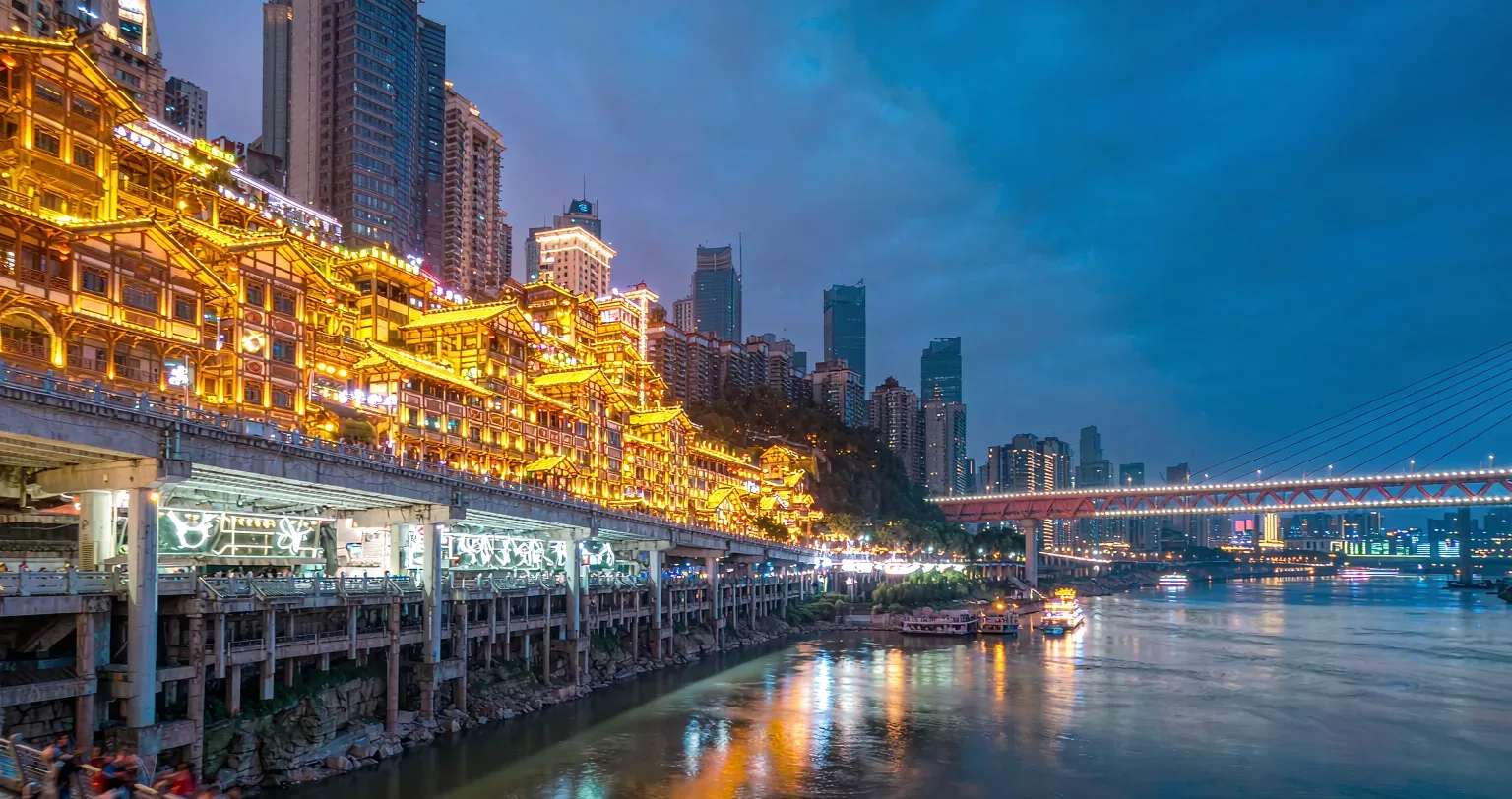
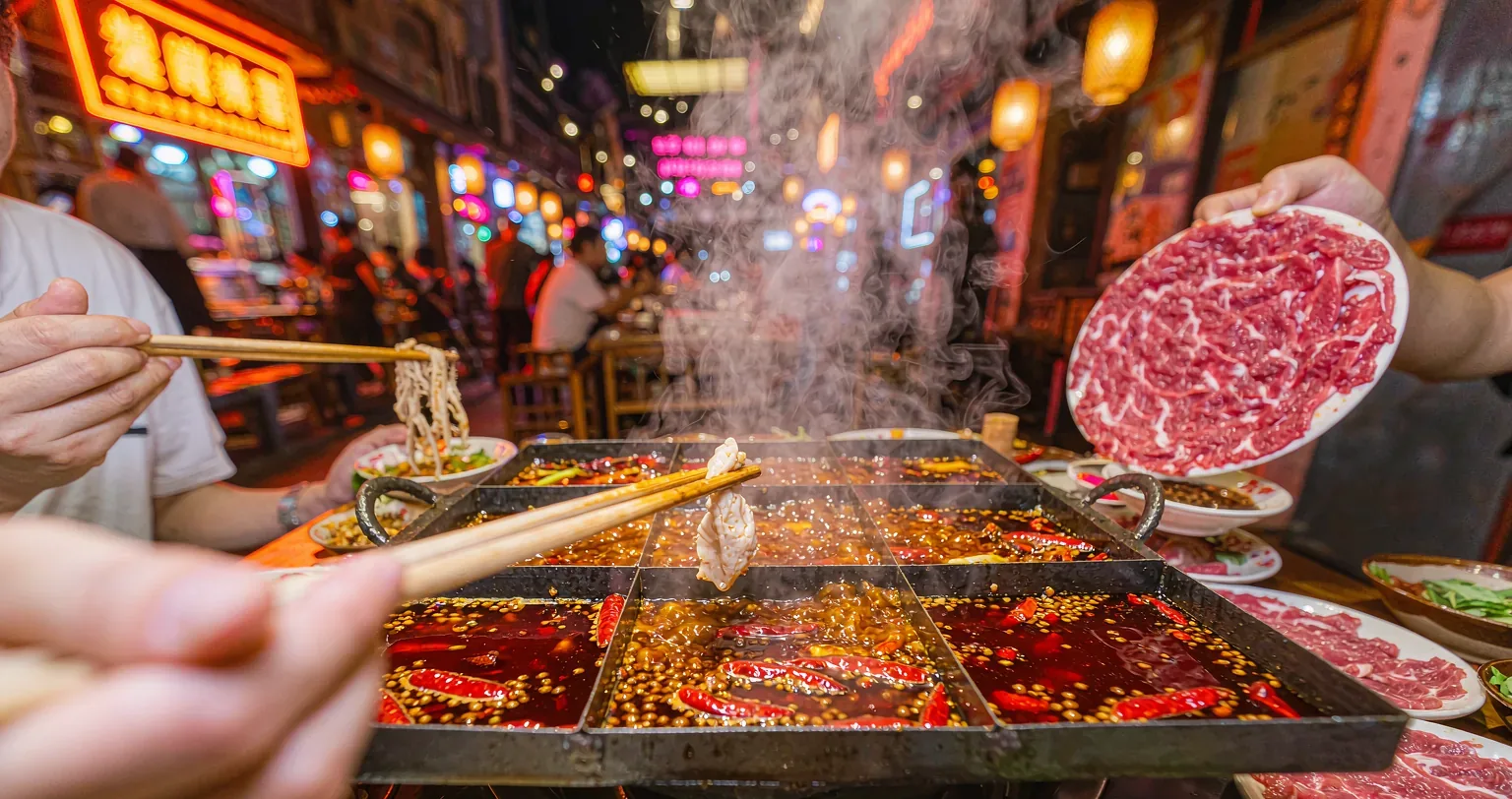
This is where hotpot was born: a boiling cauldron of chilli and numbing peppercorn shared at tables late into the night. The city at night is the other spectacle — Hongya Cave’s golden stilt-houses stacked above the river, the Yangtze cableway crossing mid-air, the ancient town of Ciqikou under its eaves of red lanterns.
Chongqing is also the boarding gate for the Yangtze: Three Gorges cruises start at its docks, the Dazu rock carvings lie an hour and a half west, and the karst wonders of Wulong are a further two hours on.
For the record: 32 million residents across an area the size of Austria; an urban core of about ten million on steep hillsides; a river cableway and one of the world’s longest metro-monorail networks; and a night skyline our travellers routinely rank alongside Hong Kong’s.
Yu the Great and Mount Tu
Legend places Yu the Great's marriage on the south bank — Mount Tu. Flood-taming kept him passing his own door three times without entering; his wife is said to have waited into stone, the Husband-Watching Rock. The river city's story is older than most histories.
The general who paid with his head
When Ba was torn by civil strife, General Ba Manzi borrowed Chu's army by promising three cities. Peace restored, he said: cities cannot be given; a head can be. He took his own and kept the city. Chongqing's prized quality — gengzhi, plainspoken loyalty — grows from this story.
Ba Manzi
The general who traded his head for his city's walls. The original text of Chongqing loyalty — in older days, boats on the river sounded their horns on his memorial day.
Wang Jian
Commander of Diaoyucheng, the Fishing Town where the Great Khan Mongol Mongke died beneath the walls. The Mongol armies turned back from Europe — chroniclers called the fortress 「where God's whip was broken.」 One hilltop city bent the curve of world history.
Lu Zuofu
Founder of Minsheng Shipping, he moved a nation's industry and its scholars upriver through the 1938 Yichang retreat — called 「China's Dunkirk of industry.」
The Three Gorges, privately
A boutique vessel with a handful of cabins, the Qutang Gorge at first light from an open deck.
Hongya after hours
The stilt-house skyline once the coaches go — then a nightcap facing the river.
Hotpot, in the courtyard
The nine-grid pot with a chef who tunes the numbing heat to you, in a Qing-era courtyard.
Cable car over the Yangtze
The old river crossing at dusk, when the city lights come on across the water.
Dazu stone carvings
A UNESCO grotto day with an art historian — the Song-dynasty cliff figures, nearly alone.
Wulong's stone bridges
Three natural arches in a gorge you reach before the tour convoys do.
Tea above the river
A cliff-top teahouse as the fog lifts off the Yangtze — the city arriving below.
The stacked streets
On foot through the mountain lanes: the building you enter at street 1 exits at street 11.
Old paragraphs
A quiet temple courtyard, then the antiques street with a local collector.
The nine-grid pot
Hotpot in a lantern-lit courtyard — the numbing pepper explained, course by course.
Where you sleep
Design hotels on the river bend with the full skyline; a restored courtyard house in the old quarter; and on the gorge nights, the boutique vessel itself — a dozen cabins, a quiet deck.
What you eat
The nine-grid hotpot tuned to your palate, Chongqing small noodles at a morning stall with a line out the door, and Jianghu dishes that never leave the neighbourhood.
When to come
March–May and September–November; summer is fierce, winter is fog-moody and photogenic.
Getting there
Direct flights from Europe and the region; one high-speed hour from Chengdu.
Pairs with
Chengdu for pandas and teahouses — or straight down the Yangtze through the Three Gorges.