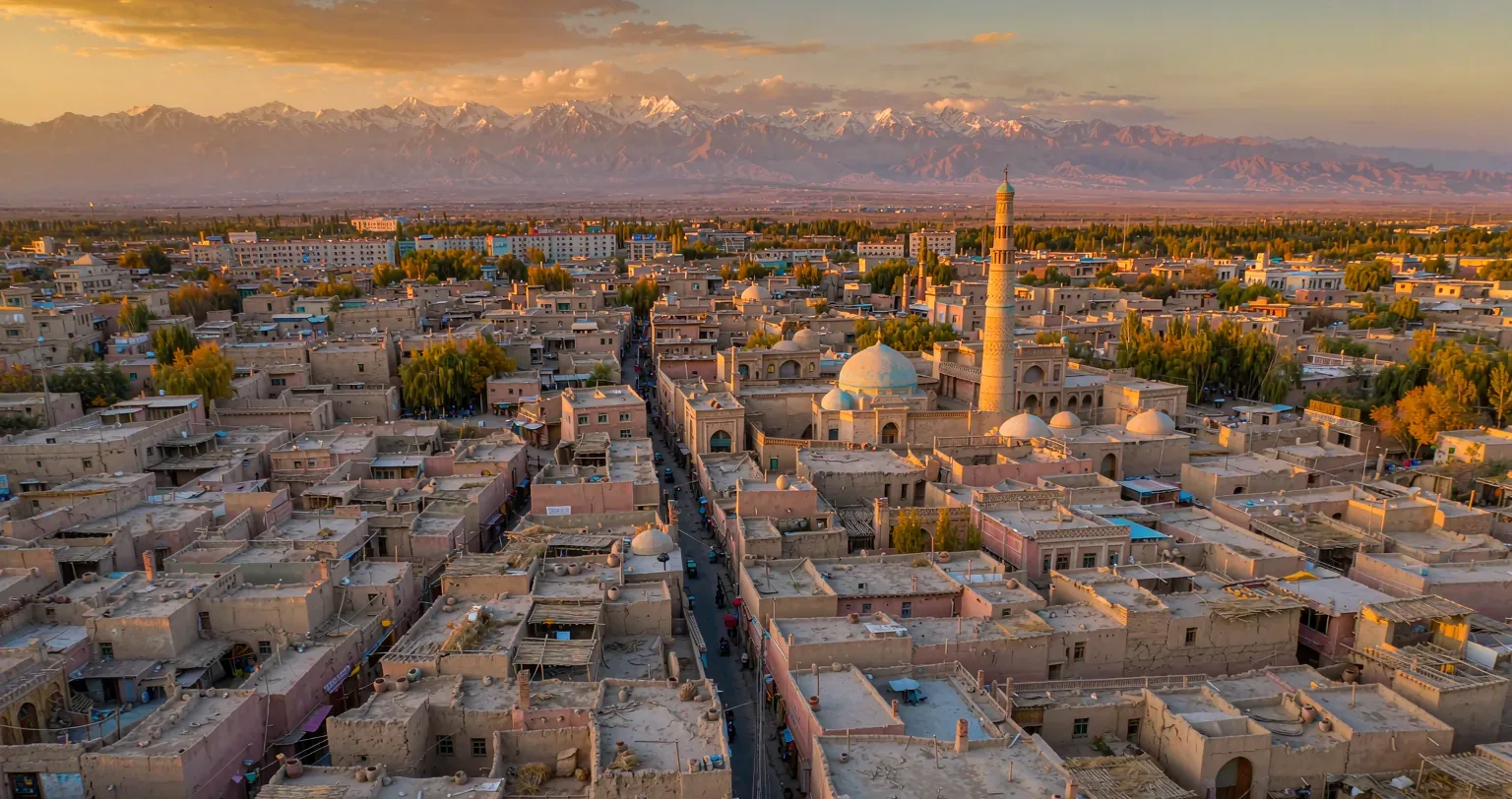
Xinjiang is one-sixth of China’s land mass, a region where the Silk Road’s northern and southern routes split around the Taklamakan Desert. Its distances are continental: Urumqi is the farthest major city on earth from any coastline, while Kashgar — more than 2,000 years old — sits closer to Islamabad than to Beijing.
The traveller’s days divide between old-town mornings and road hours: the rebuilt lanes and kite-sky of Kashgar’s old town, the livestock bazaar’s dust and bargaining, naan pulled from tandoor walls, lamb skewers over river coal, and fruit — grapes, melons, pomegranates — that justifies the region’s reputation on its own. Note the clock: locals live roughly two hours behind Beijing time, and so should you.
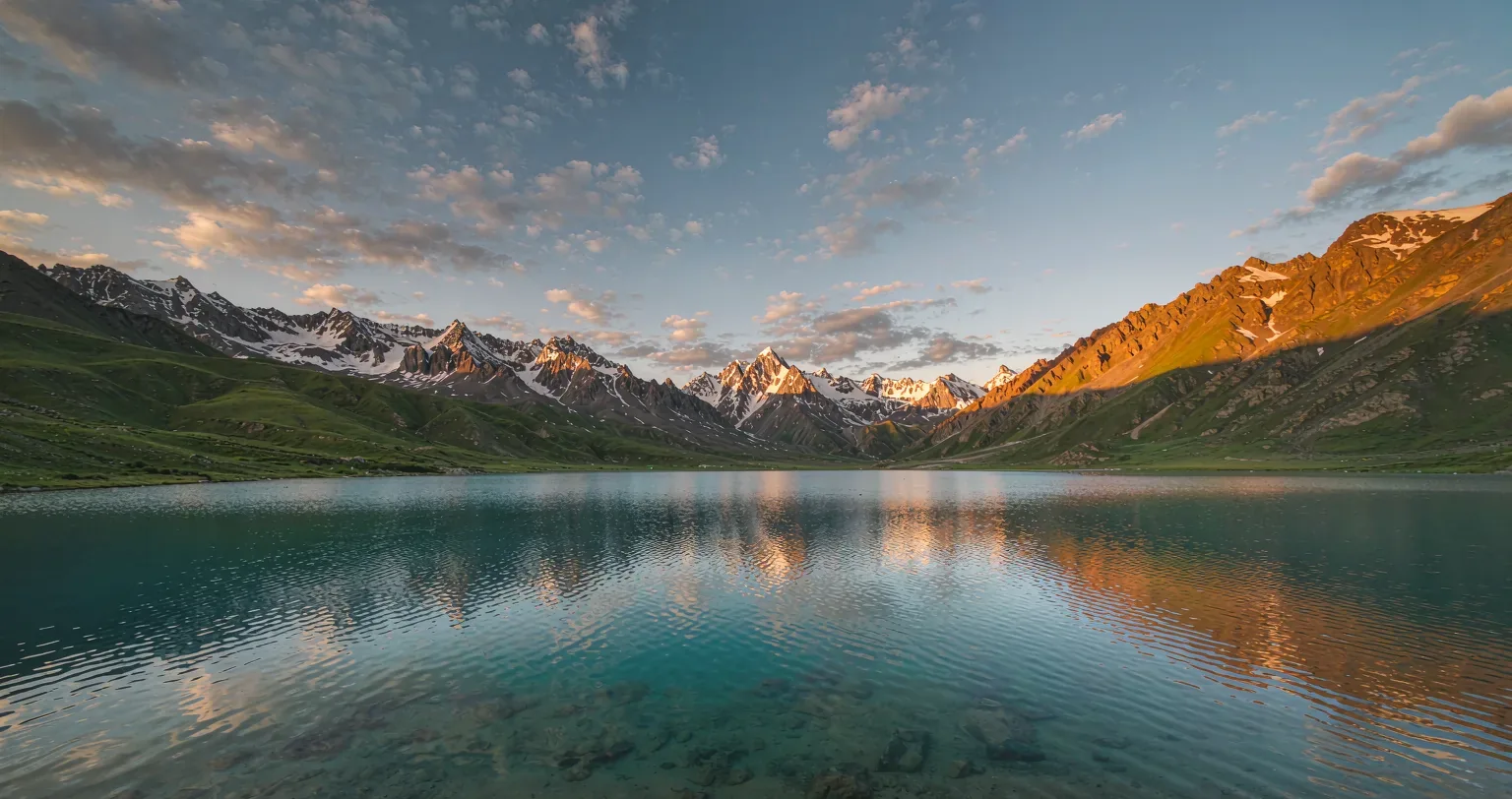
The landscapes do the rest: Sayram Lake’s cold blue at 2,070 metres, the Heavenly Lake beneath the Tianshan snows, Turpan’s ancient karez irrigation and flaming July heat, the grand canyon and the poplar gold of the far south.
For the record: 1.66 million km² — larger than Western Europe combined; Kashgar has traded on this site for two millennia; and distances are measured in half-days, which is precisely why we plan the region in private cars with dedicated drivers.
The Flaming Mountains and the iron fan
In Journey to the West, Monkey bargains three times for the iron fan that can quench the Flaming Mountains' eight hundred li of fire. The real range is bare red sandstone that glows at noon — the novel and the geology shake hands in the heat.
The banquet at the Jade Pool
The ancient Tale of King Mu records the Zhou king driving his eight steeds west to the Jade Pool, where the Queen Mother of the West feasted him; they sang to each other and promised to meet again in three years. The pool is today's Heavenly Lake of Tianshan — China's oldest recorded appointment with the far away.
Zhang Qian
Held captive over a decade yet never surrendered his imperial staff; the grapes, alfalfa and the route he brought back were called 「the great piercing through.」 The road's first traveller.
Ban Chao
Threw aside the historian's brush for the sword — 「never into the tiger's den, never the cub」 is his line, from a night raid led with thirty-six men. He held the Western Regions for thirty-one years and went home at seventy.
The Fragrant Consort
Iparhan of Kashgar, whose legend says her body carried a natural perfume. Half of her story is in the archives, half in Kashgar's Abakh Hoja Tomb — the Silk Road's most told-about woman.
Kashgar's old city, at opening
The lanes and livelihoods with a local historian — before the heat, before the crowds.
Sayram Lake at sunrise
The last great alpine lake — horses on the shore, snow ridges behind.
The Karakoram highway
Down to Karakul Lake beneath Muztagh Ata — the day trip other borders envy.
Turpan's karez vineyards
The desert oasis engineering that made grapes possible — and a family cellar lunch.
Altay under first snow
Kanas and Hemu in autumn gold or winter white, with the Tuva horsemen.
A courtyard dinner off the bazaar
Polo and lamb off the coals in a hundred-year-old courtyard near the Grand Bazaar.
First light on the lake
Sayram Lake's first light — horses passing along the shore.
The Guozigou road
The old road between bridge and gorge; the driver knows every viewpoint bend.
Crafts of the bazaar
Coppersmiths and instrument makers — they know us; we stop and talk.
Coals and naan
Naan straight from the tandoor, lamb on red-willow skewers — the day closes in the smell of coals.
Where you sleep
Uyghur courtyard houses in Kashgar's old city; lakeside lodges at Sayram and Kanas; and in the desert towns the quiet best of a limited stock — we book the handful of rooms worth sleeping in.
What you eat
Lamb off the coals with wild cumin, hand-pulled polo in a family courtyard, Turpan grapes from the vine they grew on, and naan still crackling from the tandoor.
When to come
May–June and September–October for the north; spring and late autumn for Kashgar.
Getting there
Two hours by air from Chengdu or Xi'an to Urumqi; internal legs by private driver or short flights.
Pairs with
Gansu and Dunhuang for the full Silk Road arc — Xinjiang is its living western gate.